

ETH staking absorbs 46.6% of supply, reducing sell pressure as validator exits define volatility risk.

Ethereum staking activity pointed to a structural shift in supply behavior.
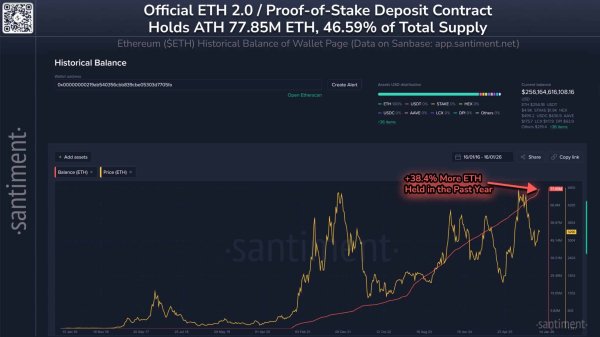
The official Proof-of-Stake deposit contract held 77.85 million ETH, valued at nearly $256 billion, representing 46.59% of the total supply.
That expansion did not occur abruptly. Instead, holdings grew 38.4% year over year, reflecting steady inflows rather than reactive locking.
Validator economics improved first, supporting longer participation horizons.
Institutional participation then added scale, reinforcing the trend.
As a result, deposits climbed gradually, with brief accelerations during strong price phases rather than abrupt surges.
Source: Santiment/X
This level of staking removes nearly half of Ethereum [ETH] from liquid circulation. Consequently, downside volatility softens as sell pressure declines.
However, the reduced float could also limit rapid upside during sudden demand spikes.
Investor intent appeared strategic. Ethereum’s stakers prioritized yield, security, and duration exposure.
In the short term, a tighter supply supported price stability. Over longer horizons, it reinforced Ethereum’s scarcity profile.
Even so, exit dynamics remained a key variable. If yields compressed or macro stress intensified, delayed but clustered exits could reintroduce volatility.
Validator growth reinforces supply lockup
Содержание статьи:
Ethereum’s validator count showed sustained expansion alongside a strengthening price structure.
Active validators ranged between roughly 977,000 and 1.04 million, up from around 890,000 at the end of 2023.
That increase signaled rising confidence among participants. At the same time, lower circulating ETH reduced short-term sell pressure.

Source: Beaconcha.in
Consequently, price action becomes stable in the pullbacks. The history of validators shows a positive movement with the ETH price cycles.
Periods of accelerating entries from the validators often preceded upward momentum.
It is worth noting that the recent expansions in the entry queues, as well as the declining exit activity, preceded the rise of ETH to the $3,300-4,500 range in the years 2025-2026.
This tendency indicates that price is not the only validator of growth. On the contrary, it strengthens it.
Additional validators seal supply, enhance network security, and ensure valuation permanence.
Exit queues remain the swing factor
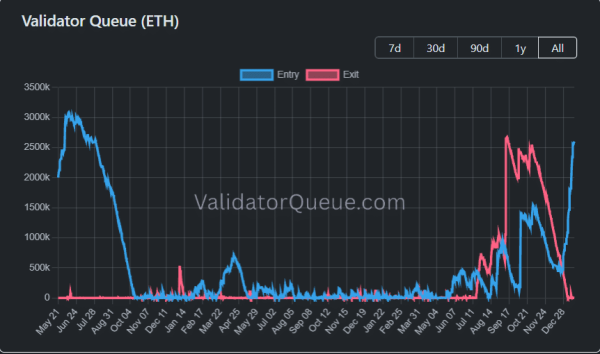
Stress has led to a surge in the number of validator exits. In mid-2022, declining prices and tighter yields reduced staking inflows, while validator exits remained impossible due to protocol constraints. Therefore, ETH was on a sell-off, but the blow was gradual. Limit taken in protocol constrained supply. In 2023, the exits normalized, and the price stabilized as confidence came back. Later, in late 2024, more intense exit waves followed.
Source: ValidatorQueue
Instead of panicking, investors agreed to embrace volatility and engage in profit-taking. Price wavered but shunned cascade selling. Entries are now reentering; exits are waning. Thus, liquidity risk appears to be managed. Staked ETH remains sticky. Exits indicate revolution, not flight. Investors should watch out for the exit acceleration. When exits win weeks over entries, the pressure of a downside increases. Otherwise, conviction dominance is in force.
Final Thoughts
- ETH staking has structurally tightened supply, reducing sell pressure and stabilizing price action. Exit trends remain the key risk metric; sustained exit acceleration would signal rising volatility, while entry dominance confirms conviction.
Next: XRP holds $2 support – Are buyers quietly taking control?
Source
